¶ The Baer House
Steve Baer's own house in Corrales, New Mexico is an artifact of his thermal philosophy — a built demonstration of the ideas that appear throughout the archive. Originally constructed in 1971 as a cluster of "zomes" (zone-dome polyhedra), it was the first full-scale testbed for drum walls, Skylid insulated louvers, and reflector/shade panels.
¶ What the photographs show
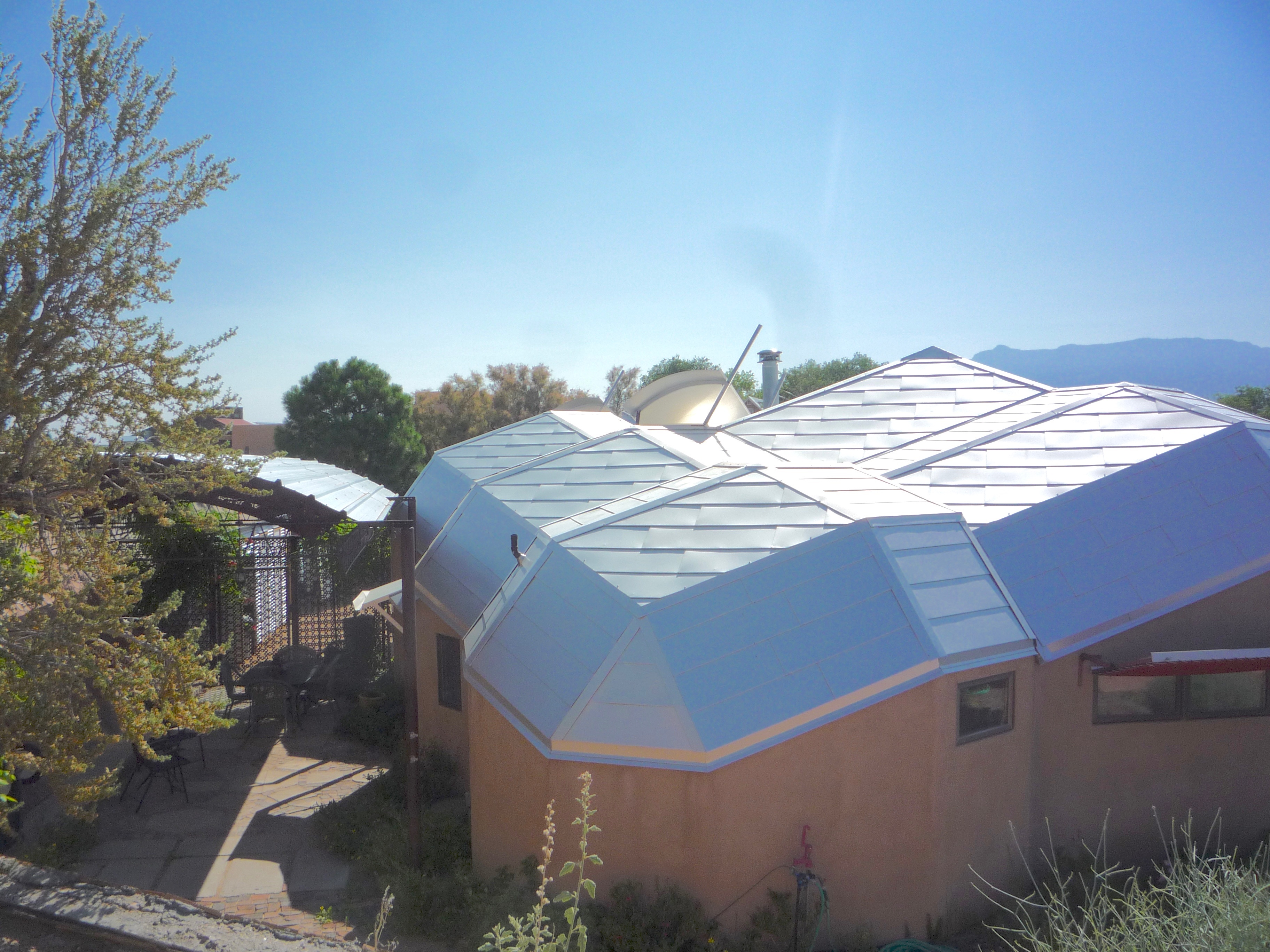
Geodesic roof — triangulated aluminum panels shed water/snow while providing south-facing exposure; Sandia Mountains in background. Multiple zome units are connected together.
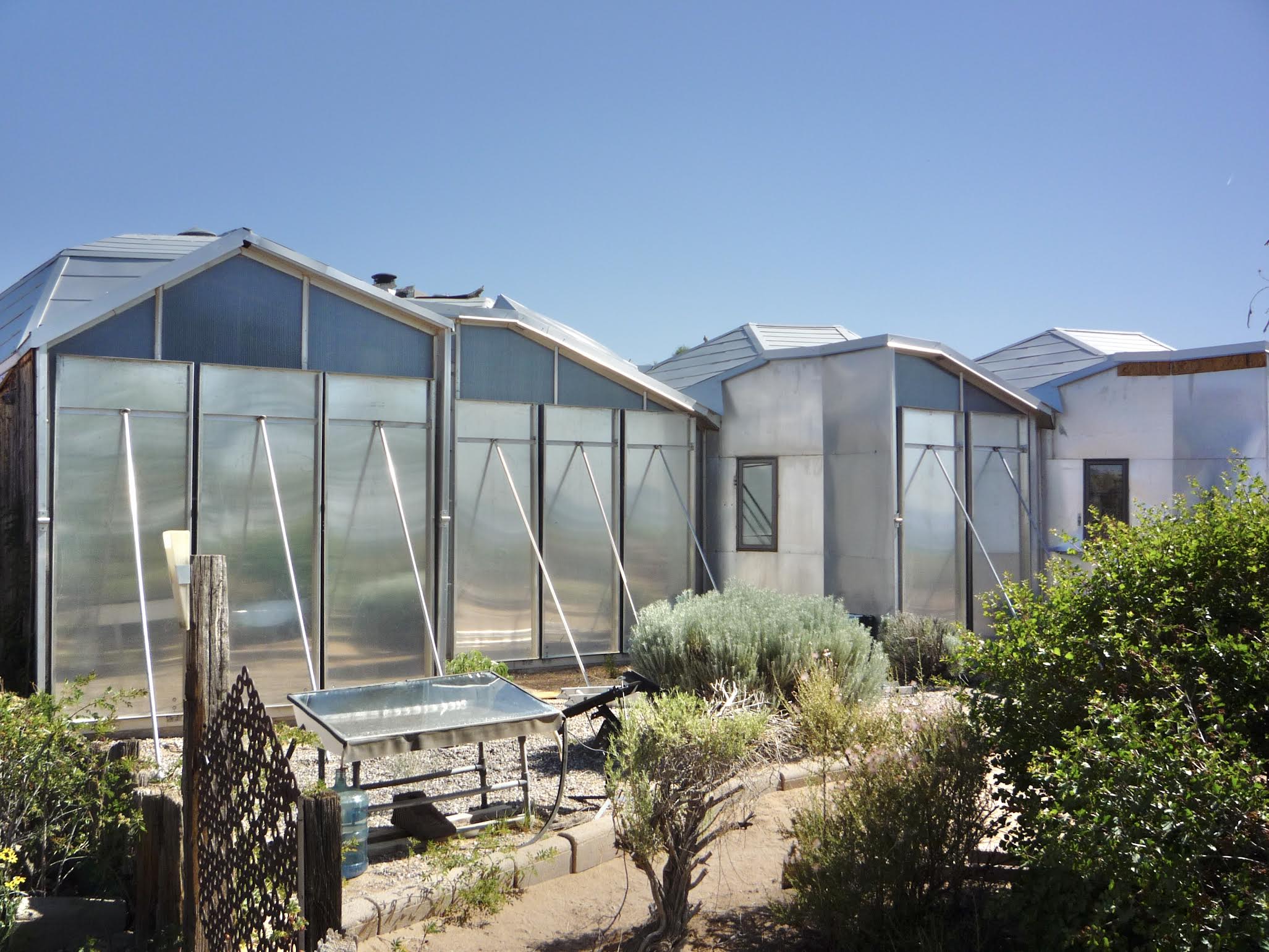
South-facing glazing with polycarbonate panels propped open for summer ventilation. In winter, the panels close against the wall to create a solar collection zone in front of the drum wall thermal mass.
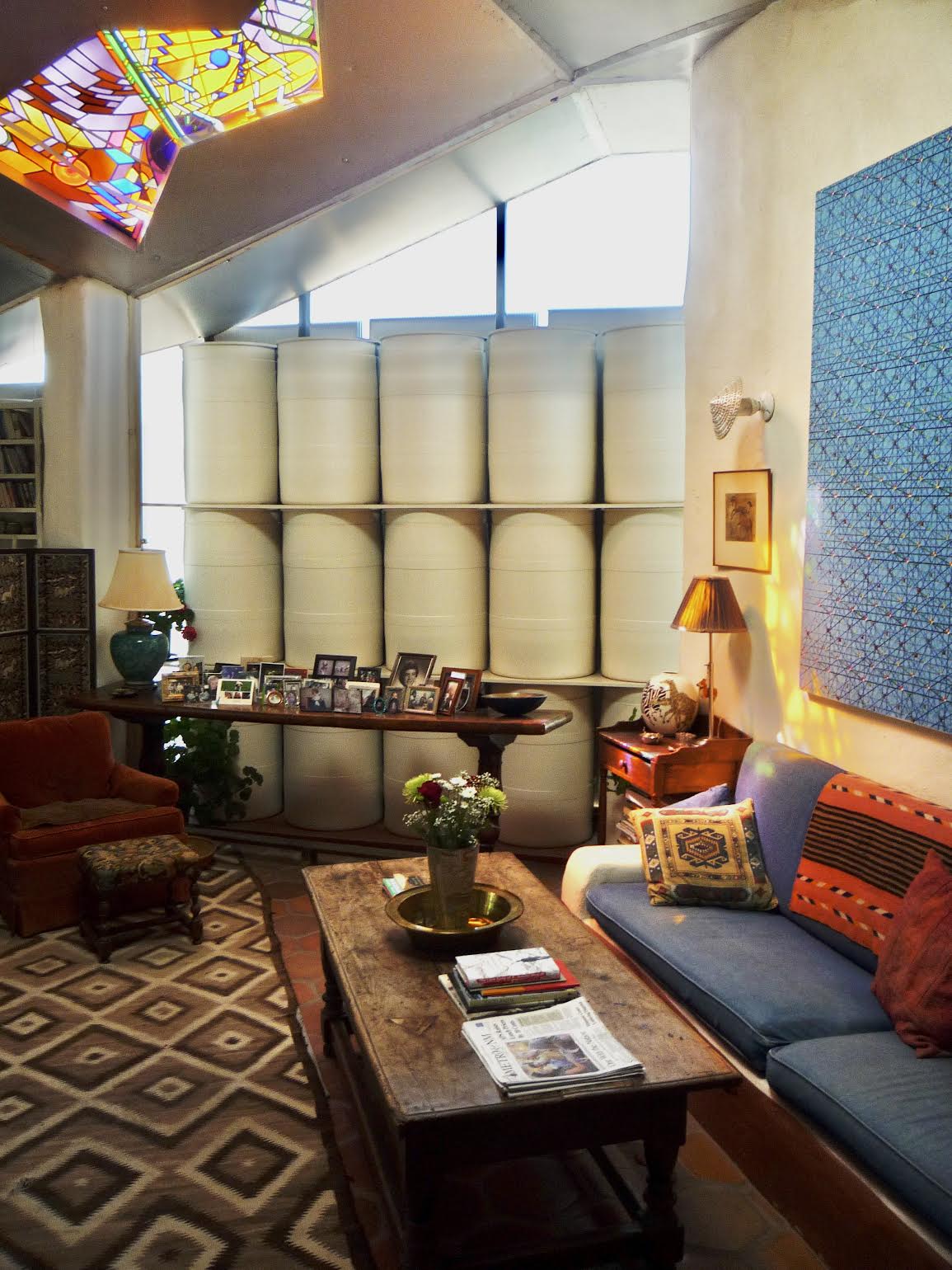
Interior drum wall — white plastic drums (replacing original leaking steel, updated ~1991) storing solar heat; stained glass Skylid skylight above.
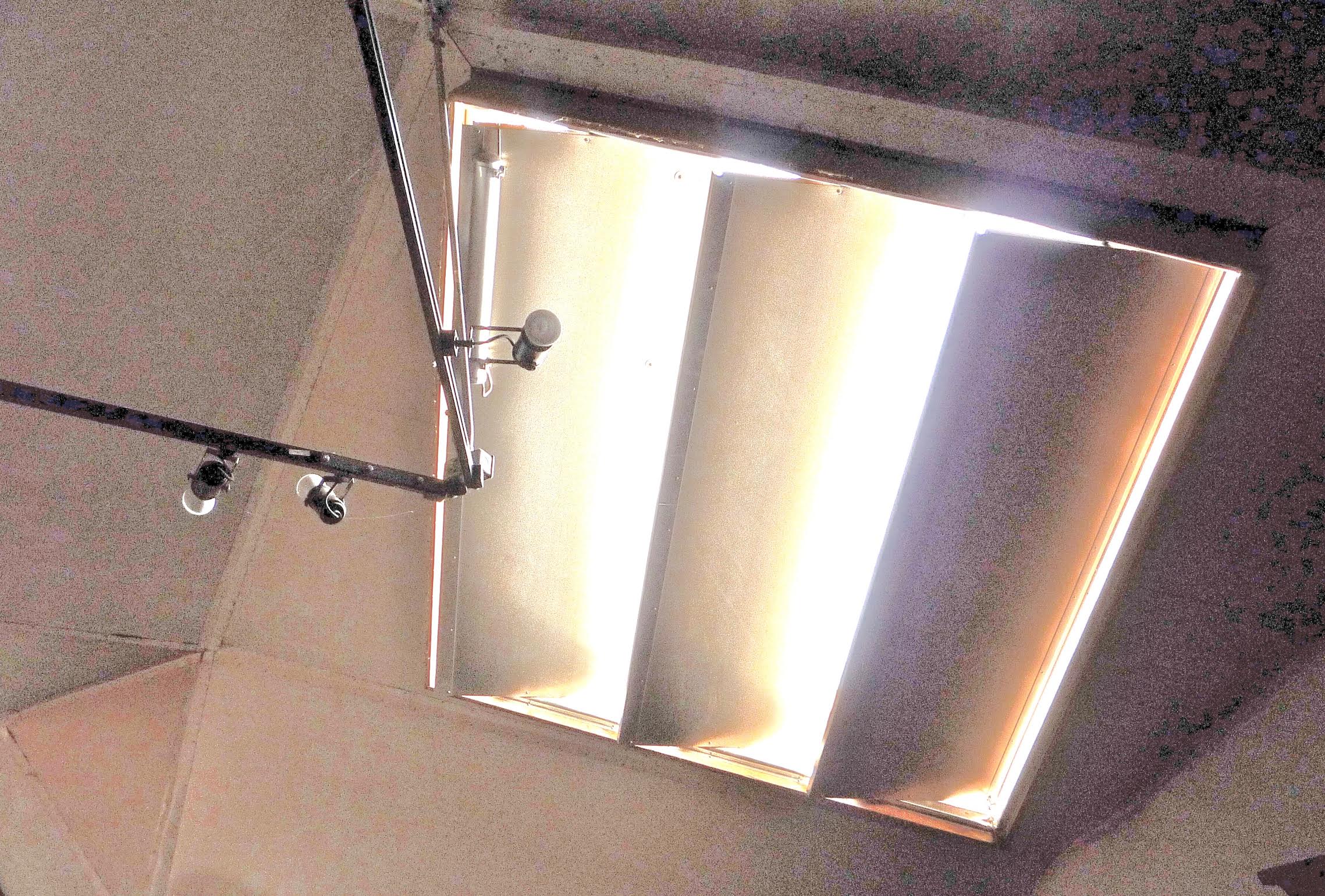
Skylid® louvers seen from below — freon-actuated bimetallic canisters open in sun, close automatically without electricity (since 1973).
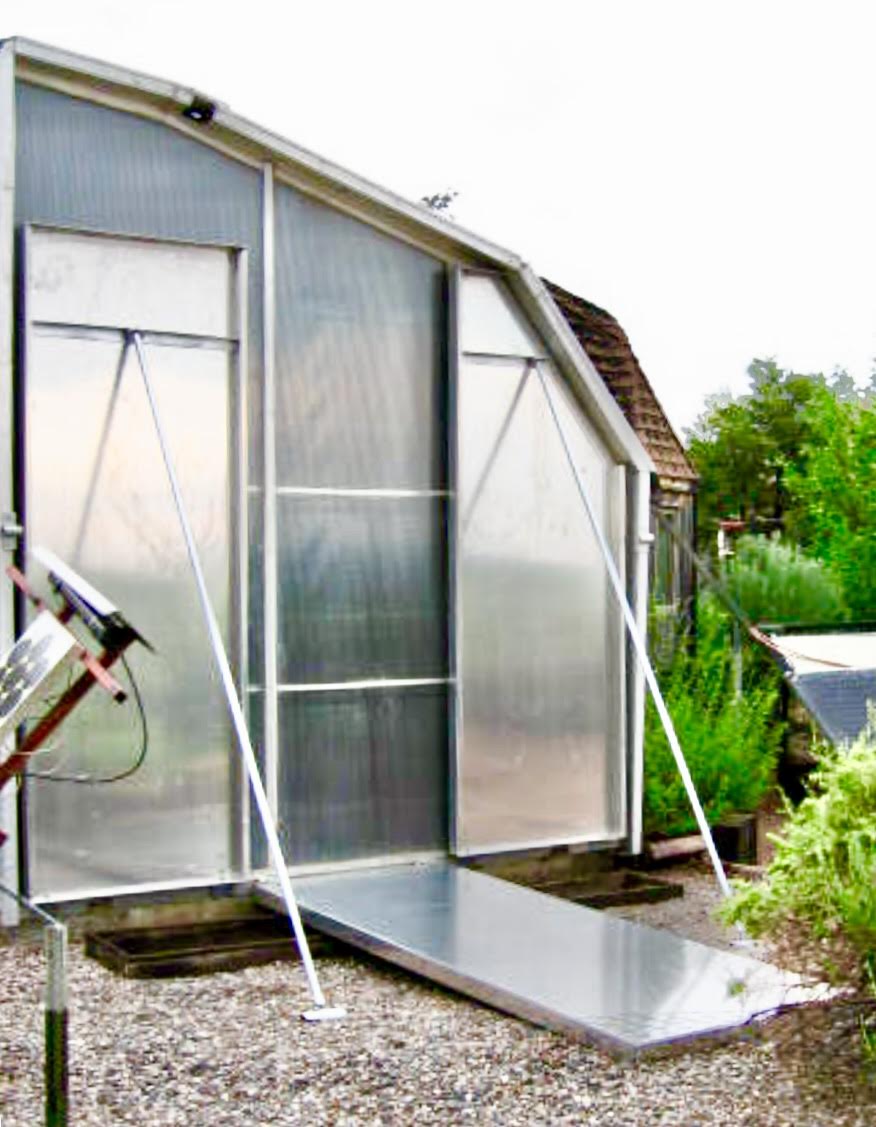
Sunbender®-related shade/reflector on outbuilding — horizontal aluminum reflector directs winter sun inward; panels prop open for summer ventilation.
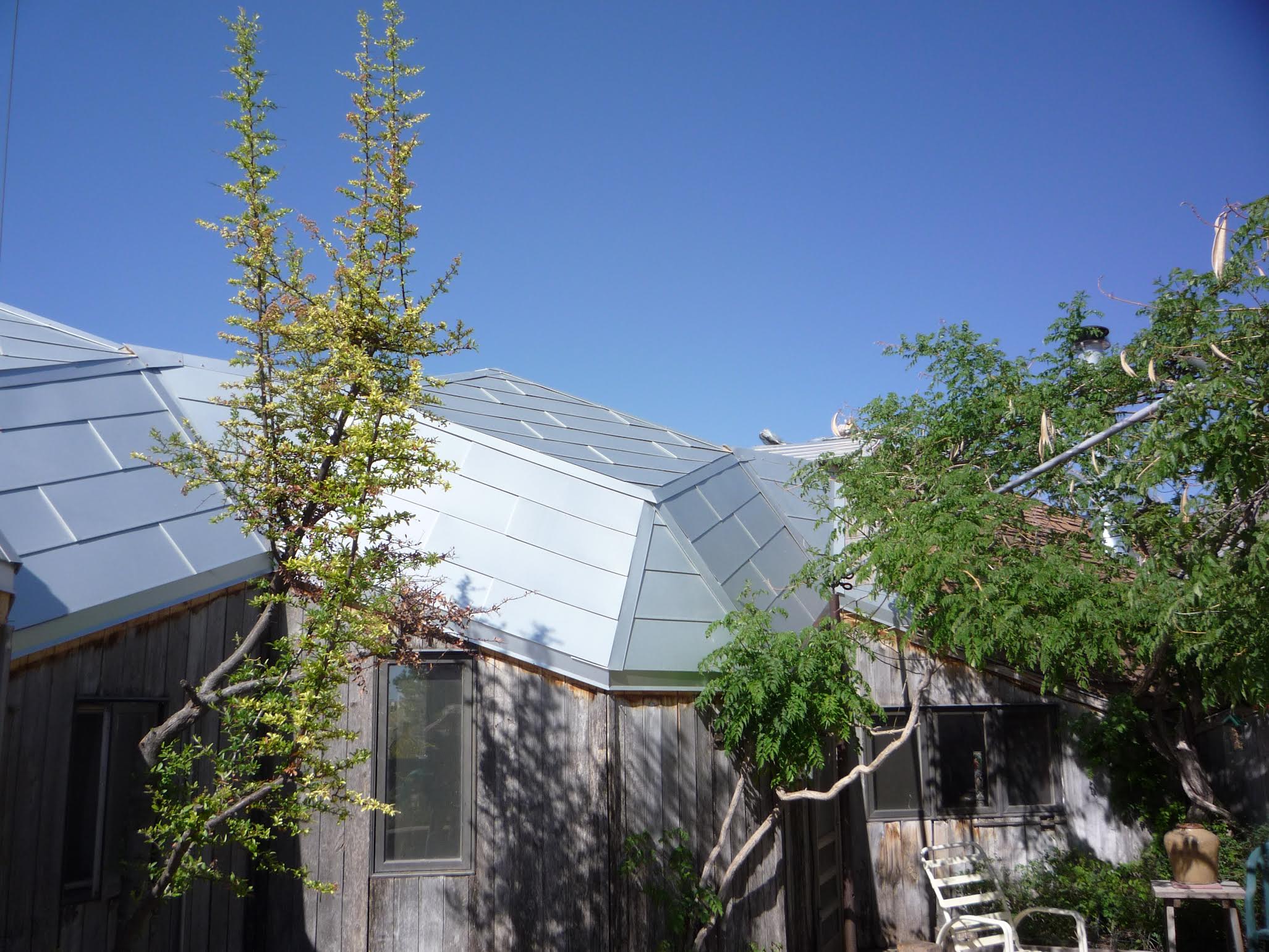
North view — weathered wood siding and sharp triangular aluminum roofline with desert cottonwoods.
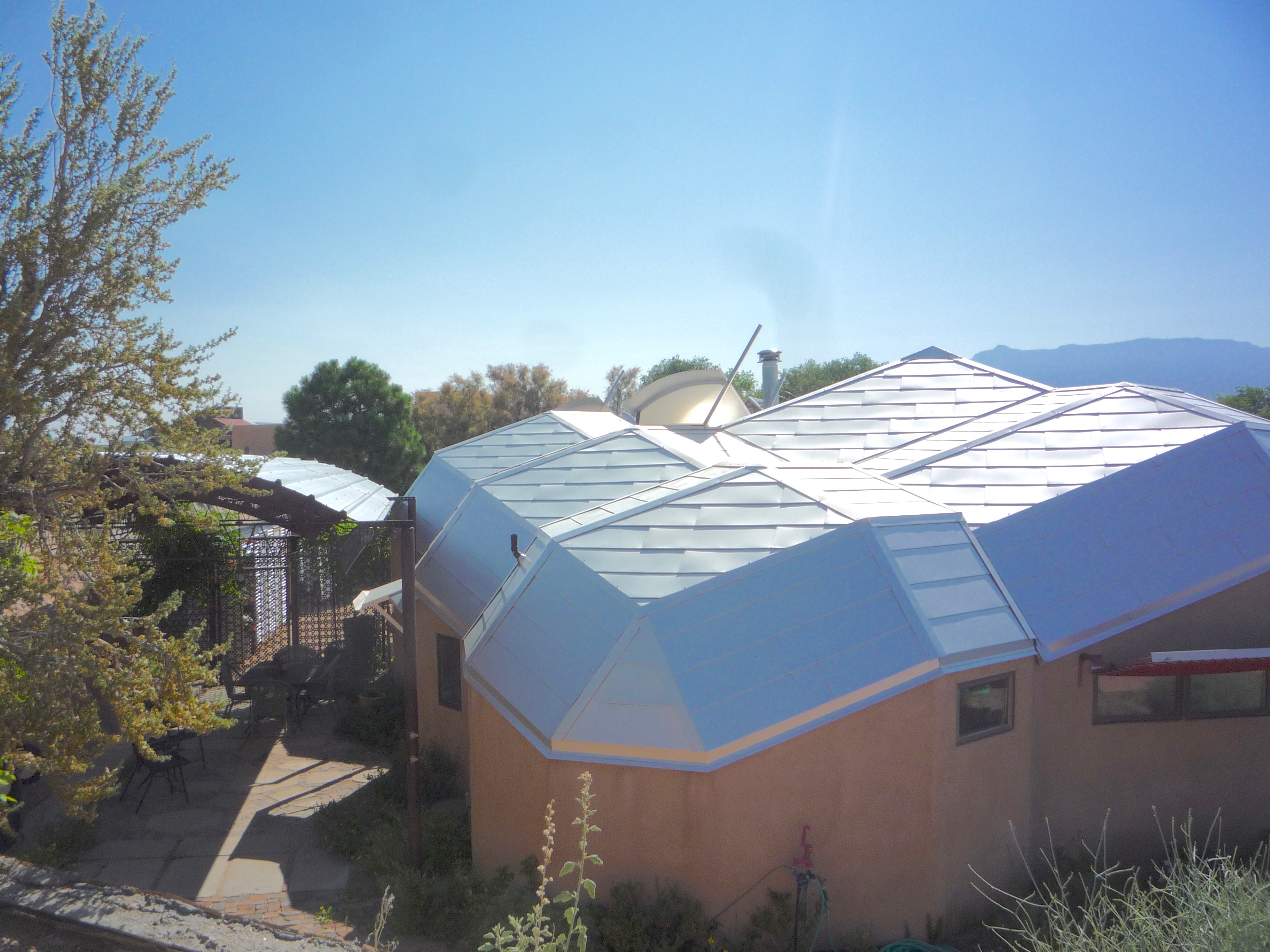
The Baer House roof photographed June 2015 — visual evidence of the building's continued existence more than four decades after construction.
¶ Why it matters
¶ Seven years in the making
The Baer House did not appear in 1971. It was the conclusion of a seven-year research arc that the Dome Cookbook (1968) and the patent record now document in detail:
- December 1964, Zurich — Holly Baer made the first rhombus-icoso-dodecahedron model on the attic floor of her grandmother's house. This is the earliest documented date for Baer's zonohedra geometry research — four years before Drop City.
- Spring 1965, Albuquerque — Baer already working on zonahedra in Albuquerque before Drop City existed.
- April 1966 — First visit to Drop City. Baer's journal: "seeing Drop City specially the mistakes and weak materials gave me great confidence." Berry Hickman and Ed Heinz — both later Zomeworks co-founders — appear in the Dome Cookbook's closing pages as active collaborators during this period, before Zomeworks existed.
- 1966–1968 — Construction practice at Manera Nueva (Placitas, NM) and the Llama Foundation zome (32' high, 46' corner-to-corner), using car tops and salvaged lumber.
- 1968 — Zonohedra structural system patent filed (US 3,722,153, issued 1973). The word "zome" coined with Durkee.
- 1971 — The Baer House built in Corrales as the first permanent, full-scale demonstration of everything learned.
By the time the house was built, Baer had already been building and failing and revising zonahedra structures for seven years. The house is not an experiment — it is the result of one.
¶ The patent lineage
The Baer House is the physical origin of a 30-year patent sequence:
| System | First demonstrated | Patent | Issued |
|---|---|---|---|
| Zonohedra structure (zome form) | 1964–68, Zurich/Drop City | US 3,722,153 | 1973 |
| DrumWall | 1971, this house | — | — |
| Skylid | 1971–73, this house | US 3,884,414 | 1975 |
| Sunbender tracker (gas spring) | 1970s, this house/outbuildings | US 4,476,854 | 1984 |
| Summer/winter louver control | 1970s | US 4,505,255 | 1985 |
| Battery cabinet cooling | 1989 (phone company product) | US 4,913,985 | 1990 |
| Ceiling water container (Cool Cell precursor) | 1991 | US 5,070,933 | 1991 |
| Passive cooling with outdoor roof radiator | 1994 | US 5,316,872 | 1994 |
| Corrugated-roof Cool Cell | 1995 | US 5,513,696 | 1996 |
| Cool Cell architectural system | 2000, Andy Shack test building | US 6,357,512 B1 | 2002 |
Every patent in this sequence — spanning from 1970 to 2002 — traces its conceptual origin to principles first demonstrated or tested at the Baer House. The DrumWall and Skylid here were not prototypes for a product: they were the product's proof of concept, running for decades before commercialization.
¶ Two product lines, one building
The house demonstrates two distinct Zomeworks product lines simultaneously:
Thermal mass + passive control: DrumWall → Skylid → Cool Cell. The drums absorb solar heat; the Skylids control when that heat enters and when it is retained; the logic was later formalized into the Cool Cell ceiling-reservoir + roof-radiator architecture. The 1991 patent (US 5,070,933) — a water container coupled to a ceiling — is a direct engineering descendant of the drum wall sitting in this room.
Solar tracking and shading: Sunbender → Gas Spring Tracker → Summer/Winter Solar Control. The shade/reflector panels visible in photographs of the south elevation evolved through four patents (1975–1985) into the Sunbender product, which uses the same refrigerant-canister physics as the Skylid to track the sun and switch between winter gain and summer shade modes.
¶ The scholarly and historical record
The Kayatekin academic paper (2025, ICON: Journal of the International Committee for the History of Technology, vol. 30, no. 2) establishes the house in the international scholarly record as the physical origin of a "broadly overlooked" chapter of American engineering history. Kayatekin traces the lineage from the New Communalist counterculture — Drop City, the Lama Foundation, the commune-building network of the late 1960s — through the house's construction to the 2002 Cool Cell patent.
The Dome Cookbook (1968) provides the earliest documentary layer: Baer's own account of the geometry research, the construction experiments, and the formation of the collaborative circle — Hickman, Heinz, and others — that became Zomeworks. The house is where that circle's work culminated.
No other surviving structure demonstrates all of these threads simultaneously: the zonohedra geometry, the passive thermal mass, the self-actuating louvers, and the reflector/shade system — in original or near-original condition, still functioning, after 55 years.
¶ See also
- Zome
- DrumWall
- Skylid
- Steve Baer
- Cool Cell architectural climate-control
- Di-thermal roofs
- Overhead thermal shutters
- Double plays old and new
- Baer AIA passive solar slideshow
- Bruce W. Davis
- Steve Baer and the double-play thermosiphon
- Archive photographs
- Evolution of the thermal vision
- Index
- Zomeworks shipping container prototype
- 2006–2017 independent work bundle
- Zomeworks Corporation
- Sunbender
- Baer House preservation guide
- Drop City
- Jose Baer
- Holly Baer
- Karen Terry